|
While you're visiting Downtown Suffolk, here are a few of our nearby attractions and eateries for your reference. For a complete list of attractions, dining and accommodations information, please check out DowntownSuffolkVa.com
|
|
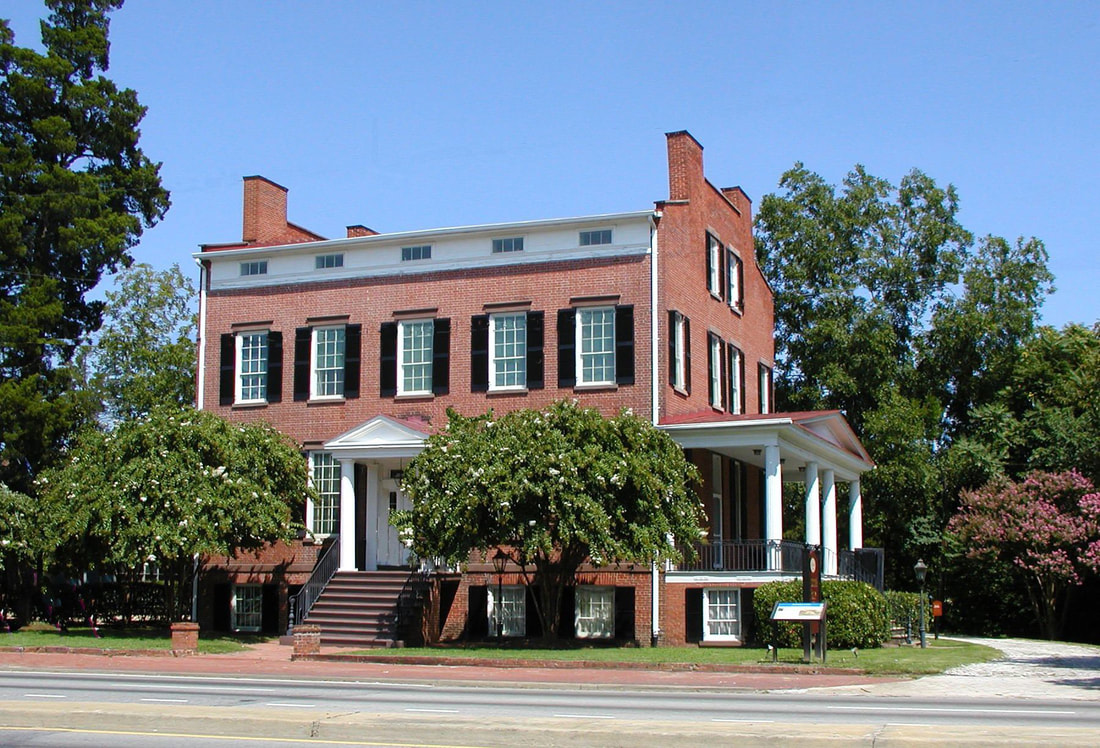
Riddick's Folly House Museum
510 N. Main Street | Suffolk, VA 23434 757.934.0822 | riddicksfolly.org While Mills Riddick's contemporaries may have mocked his Greek Revival home when it was built in 1837, the house now stands as a beautiful reminder of the past. The impressive structure is situated on North Main Street and features striking architectural details. Riddick's Folly has 4 floors, 21 rooms, and 16 fireplaces. All 4 floors are open to the public. The building features elegantly furnished double parlors, a gentlemen's library, and adult and children's bedchambers. Also open are the laundry and dining rooms and the kitchen. |
|
Suffolk Visitor Center
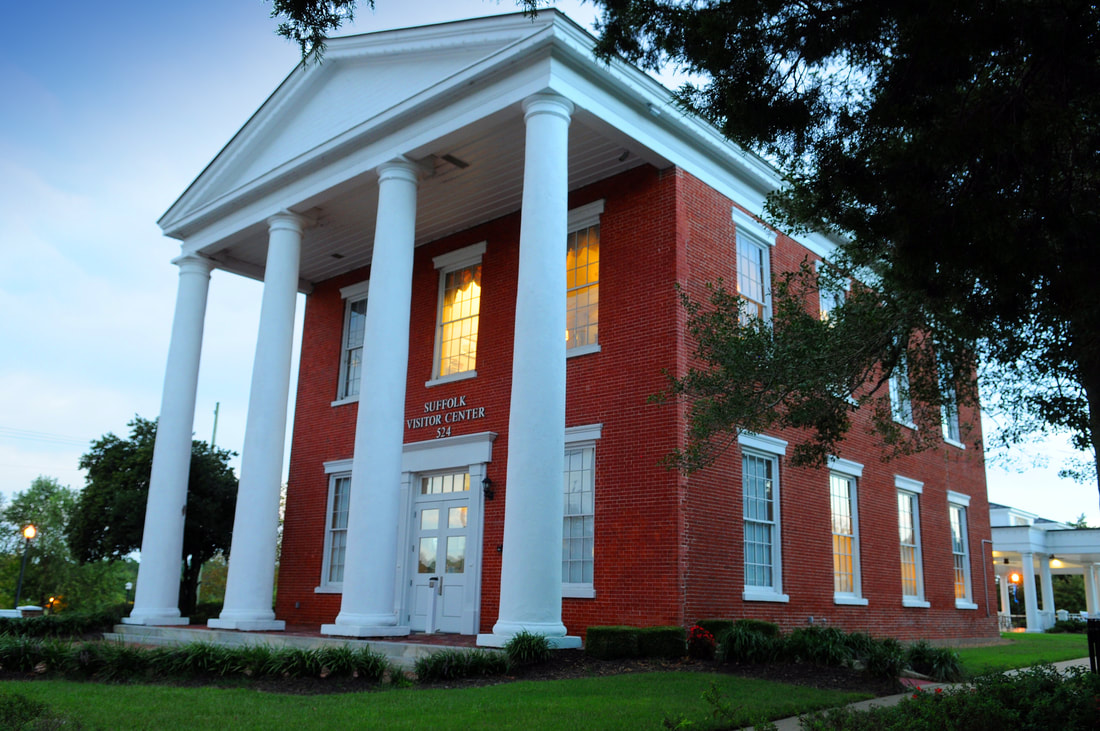
at the Historic Nansemond Courthouse 524 N. Main Street | Suffolk, VA 23434 757.514.4130 | VisitSuffolkVa.com Overlooking the Nansemond River, the provincial Roman Revival style structure with its very tall Tuscan columns was an impressive site for early travelers arriving on the river. Today the building retains its commanding presence and historical significance as the Suffolk Visitor Center. The first floor provides an exhibit gallery highlighting the history of Suffolk and the Great Dismal Swamp, a greeting and information area and a gift shop. The second floor houses municipal offices for the Department of Economic Development and Division of Tourism. |
|
Phillips-Dawson House
137 Bank St. | Suffolk, VA 23434 757.539.2781 | suffolkhistory.org The beautiful Phillips-Dawson house has been the headquarters of the Suffolk-Nansemond Historical Society for over 21 years but has a rich history all its own. The architecture of the home is French Second Empire with its mansard roof and mahogany front door with leaded glass sidelights. The stunning cascading staircase in the entryway gracefully greet each visitor to the property. |
|
Suffolk Center for Cultural Arts
110 W. Finney Ave. | Suffolk, VA 23434 757-923-0003 | SuffolkCenter.org Suffolk High School, built in 1922, has been restored and repurposed as the premier visual and performing arts venue for Suffolk. In the heart of downtown, the classic Greek-Revival structure houses a 500 seat theatre which is the stage for: Ballets, Children’s Plays, Concerts, Dramatic Works, Films, Musicals, Symphony Performances, and more! The 78,000-square-foot facility offers studios for dance, painting, sculpting, weaving classes and several other arts related classes. Within the massive 3-story Center, there is a ballroom and banquet hall, and classroom museum. |
|
Suffolk Art Gallery & Suffolk Art League
118 Bosley Ave. | Suffolk, VA 23434 757.514.7284 | SuffolkArtLeague.com suffolkva.us/1744/Suffolk-Art-Gallery The Museum hosts a variety of exhibits and through a partnership with the Suffolk Art League and the Virginia Museum of Fine Arts offers year-round programming. From painting and pastels to weaving and quilting, you can find a variety of art classes and workshops offered by the Suffolk Art League. |
|
St. Paul's Episcopal Church
213 N. Main St. The Anglican faith came to Virginia at nearby Jamestown in 1607 with the first English settlers. By 1642, the Suffolk area, which was then part of Nansemond County, was divided into three parishes, and today's downtown region was then known as the Parish of the Upper Nansemond.
Five church buildings, in five distinct locations, have served St. Paul’s throughout its history, including our present home. The earliest church is believed to have been constructed c.1643 on the banks of the Nansemond River, just north of today’s downtown area, as transportation in this period would have been primarily by water. Around 1753, the parish moved downtown, not far from where our current building resides. The present 1895 Gothic-style church building is filled with relics from many periods of the past and reminds us not only of the historical struggles of our nation, but of our long history of building faith in downtown Suffolk. Major additions and alterations were made to the building in 1914, 1922, and 1964. Many of the features of the current sanctuary date to renovations from the 1960s. The chapel, added in 1989, features several important pieces from the distant past, including wooden tablets displaying the Lord’s Prayer, Apostles’ Creed, and the Ten Commandments. Two Queen Anne style display cases hold important pieces from our past, including a bible dating back to 1754. First Baptist Church Suffolk
237 N. Main St. Founded in 1827 following a wave of revival preaching by Elder Robert T. Daniel, Suffolk Baptist Church began with thirty-three members gathering in a meeting house on Cedar Hill. Services were initially held only once a month, but the growing congregation soon established its first church building on Mahan Street in 1828. In 1834, the church added a Sunday School with “fourteen teachers and forty-three scholars,” reflecting its early commitment to education and outreach. Two years later, the congregation relocated to a “proud white structure, surrounded by a fence,” built at its present location on North Main Street.
Throughout the nineteenth century, the church became an important spiritual and civic institution in Suffolk. In 1843, the Suffolk Sewing Society was formed, becoming one of the first women’s missionary organizations in Virginia. The church also played a role in the formation of the Southern Baptist Convention, sending Rev. Reuben Jones as a representative to the organizational meeting in Augusta, Georgia, in 1845. During the Civil War, from 1862–1863, the church building was used as a hospital for Union soldiers while Suffolk was under federal occupation. Following the war, the congregation continued to expand, establishing weekly prayer meetings in 1874 and organizing the Ladies’ Aid Society in 1878 to support church fundraising and ministries. In 1890, the original wooden sanctuary was moved to the rear of the property to make way for a new brick sanctuary, establishing the foundation for the church campus seen today. Continued growth throughout the twentieth century led to the addition of educational and ministry buildings, including the Goodwin Building in 1938, the Traylor Building in 1963, and the Family Life Center in 1989. The current sanctuary, first used in 1957, remains the center of worship and church life today. Through nearly two centuries of worship, missions, education, and community outreach, First Baptist Church has remained one of Suffolk’s most historic and enduring congregations. Oxford United
Methodist Church 601 W. Washington St. Founded in 1929 by members of Suffolk’s First Baptist Church, West End Baptist Church first worshiped in the Suffolk High School auditorium while renovating the former Gum house into its original church home. As the congregation grew during the Great Depression, plans were developed for a permanent sanctuary that reflected the prominence of Suffolk’s historic West End neighborhood.
Dedicated in 1938, the church’s Colonial Revival-style sanctuary at 501 West Washington Street was modeled after Williamsburg’s Bruton Parish Church. The brick building features a symmetrical façade, copper-clad steeple, classical detailing, and evenly spaced double-hung windows that contribute to its formal elegance. Surrounded by West End’s collection of Queen Anne, Colonial Revival, Craftsman, and American Foursquare homes, the church became a defining landmark within the neighborhood’s historic streetscape. The campus expanded in 1952 with the addition of an education building designed by architect Alexander Du Pre Breeden to complement the sanctuary’s historic design. Today, West End Baptist Church remains one of Suffolk’s most recognizable historic religious landmarks, reflecting nearly a century of worship, community life, and architectural preservation. |
Mahan Street
First Baptist Church 112 Mahan St. In 1866, a few consecrated Christians dared to assemble themselves together in order to worship God as their Creator, Redeemer, and Sustainer. First Baptist Church, as we know it today, is a tribute and lasting memory to those who had the vision to venture out during those days of immediate post-slavery and the early Reconstruction Era.
During those difficult days those dedicated Christians gathered in a house located in the Cedar Hill Cemetery, Main Street, Suffolk, VA. Worship was held in this house until 1868, at which time Rev. Corprew, a Circuit Rider, who served the group, moved the congregation to an old two-room brick house on the corner of North Main and Mahan Street, then known as Second Cross and Main Streets. (It is interesting to note that this house served as one of the impromptu headquarters of President George Washington during the Revolutionary War). In 1870, this small band of Christians moved into their first church home on what was then Back Street, now known as Church Street. The land for their first church home was given by Alfred Adkins. A total of twelve (12) pastors and one (1) circuit rider have served our church since its inception in 1866. We have been richly blessed to have had spirit-filled, anointed, and trained ministers in the Gospel to lead, serve, and to teach the word. Suffolk Christian Church
216 N. Main St. The congregation dedicated its Romanesque Revival sanctuary on March 10, 1861, on the present site. This style, which arrived in America in 1840, is characterized by:
West End Baptist Church
105 Saint James Ave. Founded in 1929, West End Baptist Church first worshiped in the Suffolk High School auditorium while members renovated the former Gum house into a temporary church home. By July of that year, services were being held in an auditorium created from the home’s former kitchen and dining room. Though modest, the building quickly became the center of church life and reflected the determination of the young congregation during the hardships of the Great Depression.
As membership continued to grow, the congregation envisioned a more permanent and architecturally significant sanctuary. On December 4, 1938, West End dedicated its new church building, designed in the style of Williamsburg’s historic Bruton Parish Church. The Colonial Revival-inspired sanctuary, admired for its symmetry, dignified design, and beautiful interior, was described at the time as “among the most beautiful places of worship in the South.” The building established West End as both a spiritual and architectural landmark within Suffolk. The campus continued to expand throughout the twentieth century with the addition of an education building in 1952, designed by the same architect, Alexander Du Pre Breeden, to complement the sanctuary’s historic style. Later renovations included updates to the chancel, Fellowship Hall, and modern climate systems, while preserving the church’s traditional character. Today, West End Baptist Church remains one of Suffolk’s most distinctive historic church properties, reflecting nearly a century of worship, community, and architectural heritage. |
Main Street United
Methodist Church 202 N. Main St. Founded in 1801, Suffolk’s Methodist congregation first gathered in a modest meeting house known as Union Chapel on Cedar Hill, where multiple denominations worshiped together. As the congregation expanded, a dedicated brick church was constructed on North Main Street in 1823. By 1861, continued growth led to the completion of a larger brick sanctuary just south of the original building. During the Civil War, while Suffolk was occupied by federal troops, the church served both as a place of worship and later as a hospital.
The present Main Street United Methodist Church was built in 1916 in the Gothic Revival style and quickly became one of Suffolk’s most recognizable architectural landmarks. Featuring stained glass windows, soaring sanctuary spaces, and intricate craftsmanship, the church reflects both the spiritual and historical heritage of the community. Over the decades, the property expanded to include educational buildings, a nationally recognized pipe organ, handcrafted needlepoint furnishings, and the Atrium addition completed in 2009. In 1987, the church was officially listed on the National Register of Historic Places, preserving its legacy as an enduring symbol of Suffolk’s history and faith community.. St. Mary of the Presentation Catholic Church
202 S. Broad Street According to records at St. Paul’s Church in Portsmouth, from 1804 the priests of Norfolk attended the entire surrounding territory, including Suffolk. In 1835 St. Paul’s received its first resident pastor and for nearly 100 years a priest from St. Paul’s served Suffolk. While it is not recorded when the first Mass in Suffolk took place, the earliest on known was in 1873 and was celebrated By Father Thomas J. Brady of St Paul's at the Suffolk home of Mrs. Elfrida Holland Lewis.
By 1908 there were 10 Catholic families in Suffolk. The original St. Mary's Women's Club was founded in 1908 and members went door-to-door asking for contributions to build a new church. The lot chosen for the church was on the corner of Smith and Broad Streets, St. Mary's present location. The lot cost $500 and the church cost $1200 to build and seated about 100 people. With about 40 families now in the Parish, Bishop Van de Vyver, Bishop of Richmond, dedicated the new Church on November 12, 1909. It was not until 1927 that Father Joseph V. Brennan, the first resident pastor, was assigned to St. Mary's. In 1929 a mission of St. Mary's was established in Franklin and in 1948 was dedicated as St. Jude's Parish. In July of 1964, the Catholic Community of Smithfield was established as a mission of St. Mary's and in 1988 was named the Parish of the Good Shepherd. As the Parish grew so did the need for a larger church. In July 1953 the original wooden building was moved to the rear of the church site and turned to face Smith Street. The present church was built in 1953-54 and dedicated on September 12, 1954. The old church was torn down in 1975 and replaced with the present two-story parish hall and education building. |